
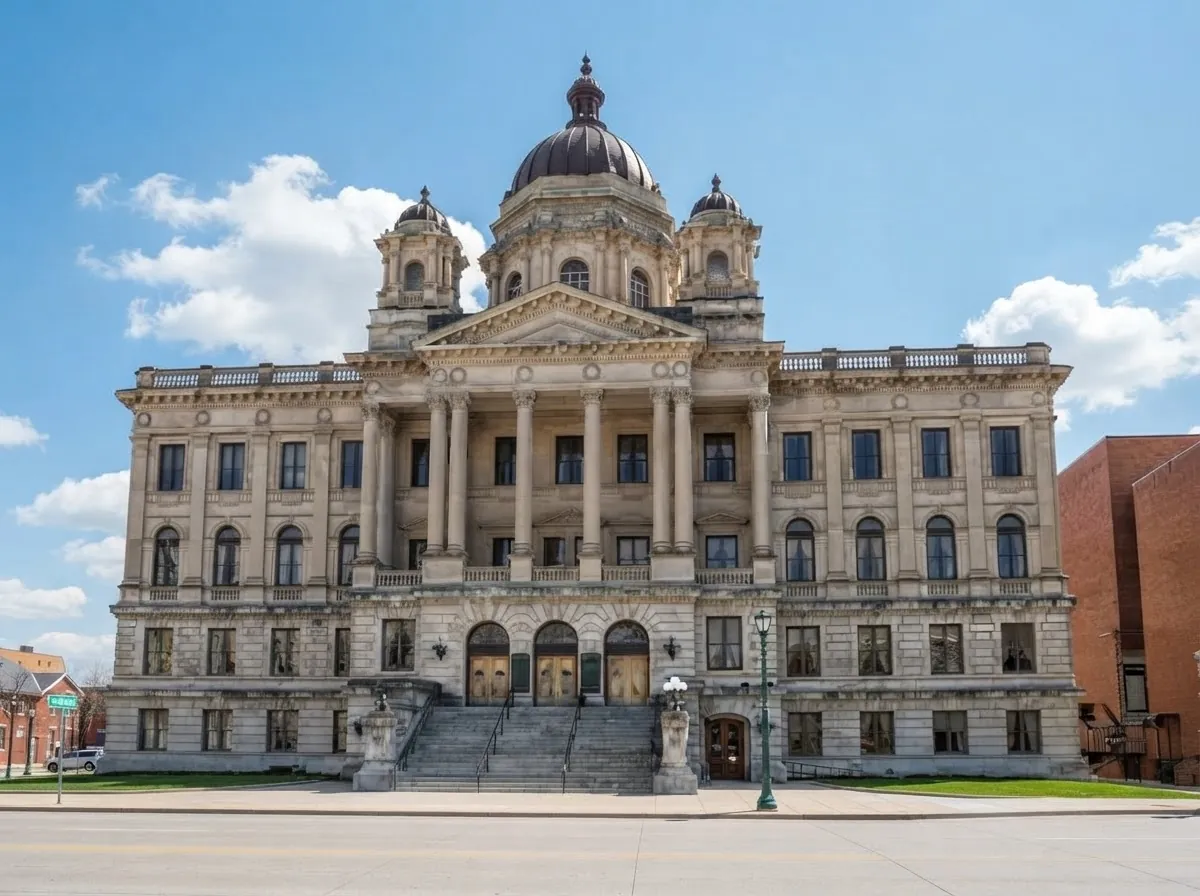
Court records for Onondaga County, New York, are maintained by the County Clerk and are accessible through online tools, official court portals, and directly at the Clerk's office. OnondagaCourt.us is a convenient resource for finding publicly available information about county court records. Additional access points include the Onondaga County Clerk's Office, the New York State Unified Court System portal, and relevant state agencies.
Onondaga Court System Overview
Onondaga County is part of the 5th Judicial District of New York State. This district also includes Herkimer, Jefferson, Lewis, Oneida, and Oswego counties. The administrative judge of the district is appointed by the Chief Judge of the state and coordinates the work of all courts within the district.
The main court complex is located in downtown Syracuse. The Supreme Court and County Court operate in the same building, while city and town courts function separately. Felony-level criminal cases are handled by the County Court, while the Supreme Court deals with civil cases without monetary limits and divorce cases.
Courts Serving Onondaga
Residents of the county are served by several courts of different levels of jurisdiction:
| Court | Address | Phone |
|---|---|---|
| Onondaga County Supreme Court | 401 Montgomery St, Syracuse, NY 13202 | (315) 671-1020 |
| Onondaga County Court | 505 S State St, Syracuse, NY 13202 | (315) 671-1020 |
| Syracuse City Court | 505 S State St, Syracuse, NY 13202 | (315) 671-2700 |
| Onondaga County Family Court | 401 Montgomery St, Syracuse, NY 13202 | (315) 671-2000 |
| Onondaga County Surrogate's Court | 401 Montgomery St, Syracuse, NY 13202 | (315) 671-2100 |
| U.S. District Court, Northern District of New York | 100 S Clinton St, Syracuse, NY 13261 | (315) 234-8500 |
Additionally, numerous Town Courts and Village Courts operate within the county, each handling minor offenses, traffic violations, and small civil claims in their respective areas.
What Types of Cases Onondaga Courts Hear
The county courts hear a wide range of cases. Here are the main categories:
- Felonies and misdemeanors (criminal cases)
- Violations (violations and infractions)
- Civil claims of any scale
- Small claims
- Family law: divorce, custody, child support
- Probate cases, guardianship, trust management
- Juvenile cases and child protection
- Traffic violations and DUI/DWI
- Adoption and paternity establishment
District Court Cases in Onondaga
In New York State, the County Court effectively functions as the "district court" at the county level. Here, a judge handles all felony-level criminal cases after an indictment by a grand jury. Civil cases with unlimited claims are heard in the Supreme Court.
Cases reach the County Court following arrest, indictment, and preliminary hearings. Judges are assigned on a rotational basis. Appeals from lower courts — City Court or Town/Village Courts — can also be submitted to the County Court. After sentencing, the convicted party has the right to appeal to the Appellate Division, Fourth Department.
Magistrate Court Cases in Onondaga
Town Courts and Village Courts in the county serve as magistrate courts. They handle misdemeanors, violations, preliminary hearings in felony cases, and small civil claims. Syracuse City Court takes on a significant portion of this workload within the city.
The limit for small claims in New York State is $5,000 in Town and Village Courts and $10,000 in City Courts. Traffic violations and DWI cases typically start here — with arraignment and preliminary hearings. If a case is classified as a felony, it is transferred to the County Court.
Family Law, Probate, and Juvenile Matters in Onondaga
Family Law. Onondaga County Family Court handles cases involving child custody, child support, protective orders, paternity establishment, and termination of parental rights. Divorces are processed through the Supreme Court, as only this court in New York has the authority to dissolve marriages.
Probate Cases. The Surrogate's Court handles inheritance cases, wills, appointments of guardians for incapacitated individuals, and trust management. Applications are submitted through the Surrogate's Court office in the courthouse on Montgomery Street.
Juvenile Matters. Family Court also deals with juvenile delinquency cases and child protective proceedings. Juvenile case records are confidential under state law. For requests regarding child abuse reports, you can contact the OCFS portal.
How Cases Move Through the Onondaga Court System
- Case Initiation. A criminal case begins with an arrest or indictment; a civil case starts with the filing of a complaint; a family case begins with a petition.
- Arraignment or First Hearing. The accused is informed of the charges and bail is set. In civil cases, the court schedules a planning conference.
- Judge Assignment. Cases are distributed among judges according to the court's internal schedule.
- Pre-Trial Phase. Parties file motions, exchange evidence (discovery), and negotiate plea or settlement agreements.
- Trial. The case concludes with a jury verdict, judge's decision, settlement, or guilty plea.
- Post-Judgment. The convicted party is sentenced. In civil cases, the winner may initiate enforcement. Any party has the right to appeal.
Court Administration, Local Rules, and Public Access in Onondaga
The administrative judge of the 5th Judicial District coordinates the work of all courts, including those in Onondaga County. Local court rules are published on the NYS Unified Court System website and cover filing deadlines, formatting, and procedures.
The County Clerk's Office is the official custodian of public records related to real estate, the Supreme Court, and Onondaga County Criminal Court. Public access to court records is governed by the New York Freedom of Information Law (FOIL). Most court records are publicly accessible, except for sealed cases, juvenile records, and certain family matters.
Hearings are generally open to the public. Some courts offer remote participation via video conference — check with the specific court's office. To obtain state police records, you can submit a FOIL request through the New York State Police website.
Court Records and Related Court Resources in Onondaga
- Court Case Search. The WebCivil and WebCrims systems on the NYS Courts portal allow for online searches of civil and criminal cases. You can also contact the County Clerk's Office directly.
- Real Estate Records. The Mortgages and Deeds Department maintains records dating back to 1794 — you can trace the history of property ownership there.
- Property Taxes. The Property Tax Search provides up-to-date information on assessments and tax obligations for municipalities in the county. Information on tax exemptions, including STAR, can be found on the Real Property Tax Services page.
- Inmate Lookup. The Sheriff Inmate Lookup is linked with the VINE system for victim notifications.
- Active Warrants. The Active Warrants List on the sheriff's website contains data from all Central New York agencies.
- State Criminal Records. The Division of Criminal Justice Services provides access to the sex offender registry, crime statistics, and criminal background checks.
- Sheriff's Office. The Onondaga County Sheriff's Office, led by Sheriff Tobias Shelley, ensures law enforcement in the county and manages the Justice Center.
- Forms and Self-Help. Self-filing forms are available on the NYS Courts portal. If you're unsure which court you need, start with OnondagaCourt.us for general orientation.